
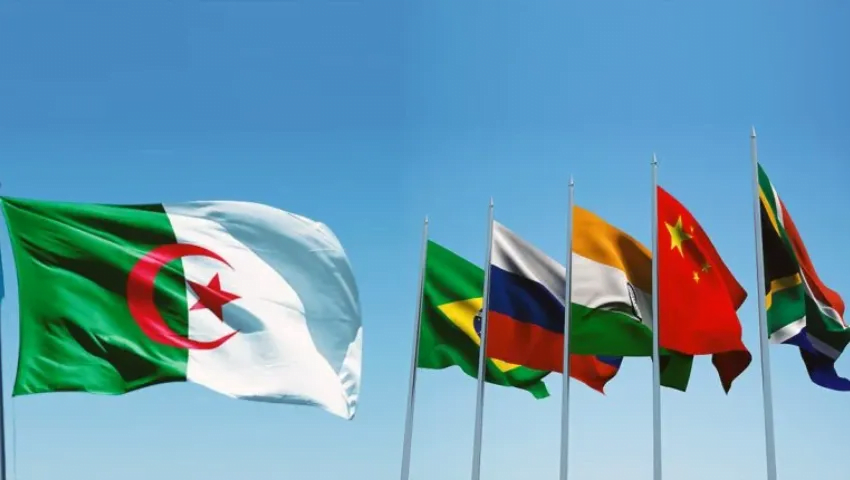
In a polarized world where global leadership is contested between a declining United States, a divided Europe, a China that is preparing to lead the world by 2049 (100th anniversary of the Chinese revolution)… Algeria is seeking to position itself as a regional and continental power by strengthening its ties with friendly countries and the emerging powers.
Algerian President Abdelmadjid Tebboune has indicated that Algeria aims to join the BRICS in 2023. However, he stressed a fundamental tenet of Algerian diplomacy: Algeria does not insult the future and respects its friendly ties with its historical partners, including China and Russia.
Who are the BRICS countries and Why does Algeria want to join?
The acronym BRICS refers to a strategic alliance of four countries with rapidly growing economies: Brazil, Russia, India and China, which South Africa joined in 2011. They represent 40% of the world’s population and 31% of the world’s GDP. In 2014, they created a development bank, based in Shanghai, which materializes their funding of economic projects. According to several projections, the BRICS will contribute 40% of global economic growth by 2025.
On the focus of their concerns are current issues that affect the economic future of each member country: the fight against protectionism, the reform of the International Monetary Fund’s governance and the International Monetary System. They are also calling for a relaxation of international environmental constraints deemed to penalize their economies. In general, the BRICS also call for the recognition of the multipolarity of world economic and political balances, breaking with the organizations inherited from the Second World War.
In a world full of challenges, since the Gulf War, the limits of international organizations have become more and more evident, starting with the UN, which was unable to prevent the invasion of Iraq.
The Security Council, whose role is to ensure peace, has turned into a council at the service of the World War II victors; all these contradictions have led regional powers to create economic and political conglomerates to serve their peoples and their vital interests.
It is noteworthy that from a geostrategic point of view, a country’s power is measured by its solid economy , its strategic vision and its geostrategic influence. Algeria is amongst the regional powers that are calling for Africa to be given a permanent seat at the UN Security Council.
Algerian President Abdelmadjid Tebboune is seeking to join Palestine as fully fledged State member of the United Nations. Algeria’s request to join the BRICS comes in a climate where tensions and crises due to the energy crunch are redefining spheres of influence. Thanks to its natural resources and its good economic strength, Algeria naturally becomes a creditable candidate to join the BRICS.
Indeed, due to its status as a geopolitical power, located at the pivot between Asia and South America, Algeria could strengthen its position on the world stage and initiate its transformation thanks to the Algerians skills established abroad, relying notably on its diversified diaspora. In terms of innovation, the country benefits from what is known as the ” backwardness advantage ” by relying on the experience of the two technological giants (India and China) which have taken a huge step in the integration and export of new technologies.
To achieve this objective, Algeria is urged to intensify its development policy for the knowledge economy and digital technologies. The groundwork has been well laid in this respect since the creation of a Ministry of the Knowledge Economy and Start-ups. One of the advantages that also favours Algeria is the absence of external debt, which reinforces its sovereignty and consolidates its position as an emerging economic power in the Mediterranean.
In addition to the economic interest, Algeria could also obtain a major diplomatic success by the announcement of this membership which would have the effect of a real territorial marketing campaign for the country, which could quadruple the FDI (Foreign Direct Investment).
Why do the BRICS make the emerging countries dream and the major powers fear?
The major challenge for the BRICS is to create a benchmark currency that would threaten the US dollar’s hegemony. After the Second World War, the Bretton Woods system set out the outlines of a new world financial architecture based on agreements signed by 44 countries in 1944. This agreement organized the global monetary system based on the US dollar; at the time, an ounce of gold was worth 35 dollars (today it is worth over 1900 dollars). It was a real paradigm shift with the emergence of debt money, a situation that puts the world economy in what is known as the TRIFFIN’s paradox.
Moreover, in order not to lose its supremacy, the United States under President Nixon suspended the dollar’s convertibility to gold in 1971. Since then the world has been living with the fluctuations of the dollar’s value. The most dangerous thing is that the US exported its inflation to the rest of the world. The use of the US dollar, which imposes the principle of extraterritoriality on any individual or legal entity that uses it for transactions, is another constraint.
The BRICS wants to put an end to this logic of hegemony and thus creates a new gold-backed benchmark. To this end, the member countries have considerably raised their gold reserves: China 300%, Russia 350%, Brazil 270%, India 128%. In comparison, the G7 countries’ reserves have decreased in recent years.
What are the BRICS membership conditions?
The conditions will be set by June 2023 at the group’s summit in South Africa. Meanwhile, both China and Russia have welcomed Algeria’s decision to join the BRICS.